In today’s digital banking ecosystem, most recurring payments EMIs, insurance premiums, utility bills, SIPs, loan repayments, subscription services—are processed automatically. One of the most common systems that enables this automation is ACH. If you’ve ever noticed a line item in your bank statement reading “ACH debit,” “ACH charges,” or “ACH return fee,” you might have wondered what it actually means.
This article explains ACH charges in detail, how the ACH system works, the difference between ACH debit and credit, why banks charge fees, and how you can avoid unnecessary penalties.
What Is ACH?
ACH stands for Automated Clearing House. It is an electronic funds transfer system that allows money to move directly between bank accounts without the use of physical checks, cards, or cash.
In the United States, ACH payments are processed through the National Automated Clearing House Association (NACHA), which governs the ACH network rules.
In India, the equivalent system is managed by the National Payments Corporation of India (NPCI), which operates ACH services such as NACH (National Automated Clearing House).
What Is ACH Charges in Banking?
ACH charges are fees associated with electronic transfers processed through the Automated Clearing House network. These charges can appear for several reasons:
- ACH debit processing fees
- ACH return or bounce charges
- Mandate registration or modification charges
- Late payment penalties due to failed ACH
- Administrative or service fees by banks
The charges depend on:
- Your bank’s policy
- The type of account
- Whether the transaction succeeded or failed
- The service provider (loan company, insurance firm, etc.)
How ACH Auto-Debit System Works
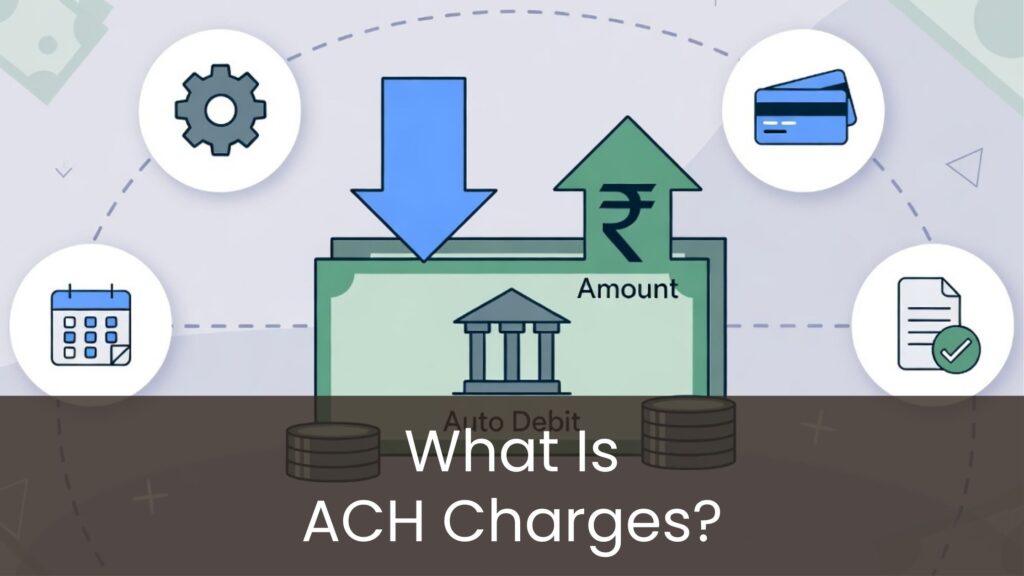
An ACH auto-debit is set up through a mandate. A mandate is your authorization allowing a company to automatically debit money from your bank account on a specified date.
Step-by-step process:
- You sign an ACH mandate (online or offline).
- The company submits a debit request to the ACH network.
- Your bank verifies the mandate.
- Funds are debited on the scheduled date.
- The money is credited to the beneficiary’s bank.
If your account does not have sufficient funds on the due date, the transaction fails, and this is when ACH return charges usually apply.
Types of Transactions That Use ACH
1. ACH Debit
Money is pulled from your account after authorization.
Example: Loan EMI, Netflix subscription, insurance premium.
2. ACH Credit
Money is pushed into your account.
Example: Salary credit, government benefits, vendor payments.
ACH charges are more commonly linked to debit transactions, especially when they fail.
Why Banks Deduct ACH Charges
Banks may charge ACH fees for administrative and processing costs. Common reasons include:
1. Insufficient Funds (Bounce Charge)
If there isn’t enough balance in your account on the debit date, the bank may charge a penalty.
2. Mandate Rejection
If your signature or details mismatch, banks may charge a rejection fee.
3. Stop Payment Instruction
If you request to stop an ACH debit, banks may apply a service fee.
4. Late EMI Payment
If an EMI fails due to insufficient funds, the lender may also charge a late payment fee in addition to bank charges.
Typical ACH Charges (Indicative)
| Type of Charge | Approximate Fee Range |
|---|---|
| ACH return/bounce fee | ₹200 – ₹750 (India) / $5 – $35 (US) |
| Stop payment request | ₹100 – ₹500 / $15 – $30 |
| Mandate registration | Usually free (varies) |
| Late EMI penalty | Depends on lender |
Note: These amounts vary by bank and country.
ACH Charges vs ECS: What’s the Difference?
In India, ACH replaced ECS (Electronic Clearing Service). While both serve similar purposes, ACH is faster and more automated.
| Feature | ECS | ACH |
|---|---|---|
| Processing Speed | Slower | Faster |
| Coverage | Limited | Nationwide |
| Mandate Management | Manual-heavy | Digital |
If your statement shows ACH charges, it means the newer system processed your transaction.
When Do ACH Charges Appear on Bank Statements?
You may see descriptions such as:
- ACH Debit Return Fee
- ACH Return Charges
- ACH Debit Failed
- ACH Mandate Charge
These appear typically when:
- EMI bounces
- Subscription payment fails
- Insurance premium not honored
- Bank account has insufficient balance
How to Avoid Unnecessary ACH Charges
Avoiding ACH fees is simple if you follow good financial habits:
1. Maintain Minimum Balance
Always keep enough funds before EMI or auto-debit dates.
2. Track Payment Dates
Set reminders a few days before scheduled debits.
3. Use SMS/Email Alerts
Enable transaction alerts to monitor debits.
4. Cancel Unused Mandates
If you no longer use a service, cancel the auto-debit authorization.
5. Maintain Buffer Funds
Keep a small buffer amount in your account to prevent accidental failures.
Are ACH Charges Refundable?
In most cases:
- If the failure was due to insufficient funds Not refundable.
- If it was a technical error by the bank You can raise a complaint.
- If wrongly charged You may request reversal.
Contact your bank’s customer care with:
- Transaction ID
- Date of debit
- Mandate details
Is ACH Safe?
Yes. ACH systems are secure and regulated by national payment authorities. They use encryption, authentication, and compliance monitoring.
However:
- Always authorize trusted institutions only.
- Never share OTPs or banking credentials.
- Monitor bank statements regularly.
Advantages of ACH Payments
- Convenient
- No need to remember due dates
- Paperless
- Cost effective compared to cards
- Widely accepted
Disadvantages of ACH
- Bounce charges
- Less control if not monitored
- Processing time (may take 1–3 working days in some countries)
- Risk of penalties if account balance is low
ACH Charges vs Debit Card Fees
| Aspect | ACH | Debit Card |
|---|---|---|
| Processing | Bank-to-bank | Card network |
| Charges | Usually low | Merchant fee applies |
| Recurring Payments | Ideal | Possible but costlier |
| Bounce Risk | Yes | Transaction declines immediately |
Frequently Asked Questions (FAQs)
An ACH charge refers to a fee related to an Automated Clearing House transaction, usually due to a failed debit or service processing fee.
It varies by bank. In India, it can range from ₹200 to ₹750. In the US, it may range from $5 to $35 depending on the bank.
Yes. You can cancel the mandate through your bank or by contacting the service provider. Some banks may charge a stop payment fee.
Common reasons include insufficient funds, account closure, incorrect account details, or mandate mismatch.
Yes. ACH payments are secure and regulated by national payment authorities like NACHA (US) and NPCI (India). However, always monitor your account activity for safety.