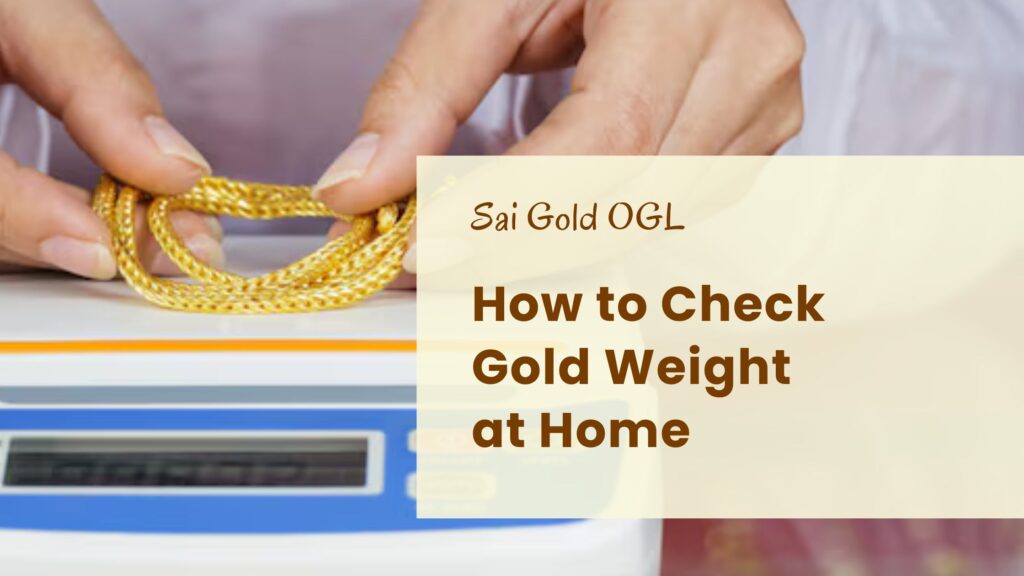
Gold is one of the most valuable metals in the world, and even a small difference in weight can significantly affect its price. While jewelers and assay offices use precision machines to measure gold, many people want to understand how to check gold weight at home, especially when selling, buying, or verifying inherited jewelry.
Although you cannot achieve laboratory-level accuracy without professional equipment, there are several reliable manual methods that can give you a surprisingly close estimate. This article explains practical, step-by-step techniques on how to check gold weight at home without using a weighing machine, along with tips to improve accuracy and avoid common mistakes.
Understanding Gold Weight Basics Before You Check Gold Weight at Home
Before measuring, it’s important to understand how gold is weighed.
Gold is commonly measured in:
- Grams (g) – most common for jewelry
- Tola – widely used in South Asia (1 tola ≈ 11.66 grams)
- Ounces (oz) – used in international bullion markets
Jewelry weight often includes:
- Pure gold content
- Alloy metals (copper, silver, zinc)
- Stones or gems, which must be excluded for accurate gold weight
Knowing this helps you avoid overestimating value.
How to Check Gold Weight at Home Using the Water Displacement Method (Most Accurate)
This is the most reliable non machine method based on Archimedes’ principle.
What You Need:
- A measuring cup or graduated cylinder (with ml markings)
- Water
- A thin thread
- Calculator
Steps:
- Fill the measuring cup with water and note the initial level (e.g., 100 ml).
- Tie the gold item with thread.
- Submerge it completely in water without touching the sides.
- Note the new water level (e.g., 104 ml).
- Subtract initial from final reading:
104 ml – 100 ml = 4 ml (volume of gold)
Convert Volume to Weight:
Gold density ≈ 19.3 g/ml
Weight = Volume × Density
4 × 19.3 = 77.2 grams
Why It Works:
Gold has a very high and consistent density, making this method effective for solid gold items.
Less accurate for hollow jewelry or items with stones.
How to Check Gold Weight at Home by Comparing with Known Gold Weight
If you already own a gold item with a confirmed weight, you can use it as a reference.
What You Need:
- A confirmed gold item (same purity)
- A ruler or balance surface
Steps:
- Hold the known gold piece in one hand and the unknown in the other.
- Compare the “heaviness” by gently balancing them.
- If one feels about twice as heavy, it likely weighs roughly double.
Accuracy Level:
- Medium
- Best for similar designs and sizes
This method is subjective but useful for quick estimation.
How to Check Gold Weight at Home Using the Coin Stack Comparison Method
This technique uses coins with standardized weights.
Example Coin Weights:
- US Nickel: ~5 grams
- Indian ₹10 coin: ~7.74 grams
- UK £1 coin: ~8.75 grams
Steps:
- Stack coins until they feel equal in weight to the gold item.
- Count the coins.
- Multiply number of coins by the coin’s weight.
Example:
If gold feels equal to 6 nickels:
6 × 5 = 30 grams (approx.)
Tips:
- Use clean, unworn coins
- Stack neatly for better balance
How to Check Gold Weight at Home with a DIY Paper Balance Scale
You can create a simple balance scale at home.
What You Need:
- A ruler or hanger
- String
- Two small paper cups
- Coins with known weight
Steps:
- Tie two cups on each side of the ruler.
- Hang the ruler from the center so it balances.
- Place gold in one cup.
- Add coins to the other cup until balanced.
- Calculate total coin weight.
Accuracy:
- Moderate
- Depends on balance stability and coin accuracy
How to Check Gold Weight at Home Using Length and Thickness (For Chains)
For plain gold chains, weight can be estimated mathematically.
Steps:
- Measure chain length using a tape.
- Measure thickness visually or with thread comparison.
- Compare with online or known gold chain charts.
This method is least accurate but helpful for rough estimates.
How to Improve Accuracy When You Check Gold Weight at Home
- Remove stones before measuring
- Measure multiple times and average results
- Ensure gold is fully submerged in water
- Dry gold completely before handling
- Avoid hollow or mixed metal items
What Checking Gold Weight at Home Cannot Do
- Determine exact purity (karat)
- Accurately measure hollow jewelry
- Replace professional jeweler results
- Certify gold for legal or resale purposes
These methods are for personal estimation only.
When to Seek Professional Measurement
You should visit a jeweler if:
- The gold is high value
- You plan to sell or insure it
- Purity is unknown
- Jewelry contains gemstones
Professional machines like electronic scales and XRF analyzers provide precise results.
Before checking the value of gold, it’s also important to know its purity.
Learn How to Check Gold Purity at Home: 5 Easy & Accurate Methods to better understand the true worth of your jewelry.
Frequently Asked Questions (FAQs)
Yes, but accuracy will be low. Methods like hand comparison can give rough estimates, but tools like water and coins improve results significantly.
Yes, pure gold does not react with water. Just avoid this method for jewelry with glued stones or delicate settings.
Home methods can be 80,95% accurate for solid gold items, but machines provide near 100% accuracy.
Yes, but this involves a machine. Kitchen scales are less accurate for small weights compared to jewelry scales.
Purity affects density slightly. Lower karat gold contains alloys, which can slightly alter results, especially in the water method.