


Gold Loan Interest Rates Bangalore will never be the same for all borrowers. Even two individuals who walk into the same office with an equal quantity of gold might end up leaving with different interest rates. Many people find it surprising and it costs them dearly.
The reason is simple. Lenders don’t pick a number out of thin air. They look at your gold, your loan size, how long you want the money, and a few other things. Even Gold Loan Interest Rates in India keep changing with RBI decisions. If you are planning a gold loan in Bangalore, this guide explains the 10 factors that decide what you pay. So, without any delay, let’s get started
What are Gold Loan Interest Rates?
A gold loan interest rate is the extra money you pay a lender for using their funds while your gold stays with them as security. It’s quoted per year and per month. At 1% a month, a ₹1 lakh loan means ₹1,000 in interest every month. That’s why the Gold Loan Interest Rate Per Month matters as much as the yearly number. Across the country, Gold Loan Interest Rates in India run from roughly 8.50% to 30% a year, depending on the lender and loan type. If you are new to this, our beginner’s guide to gold loans covers the basics.
A few simple things to remember:
- Monthly rate × 12 gives the yearly rate (0.85% a month is about 10.2% a year)
- Ask if interest is charged on the full amount or the reducing balance
- Rates change with the lender, scheme and tenure
10 Major Factors That Affect Gold Loan Interest Rates in Bangalore
1. Gold Purity, Net Weight and Valuation Method
The more pure gold you bring, the stronger your position. 22 carat jewellery is valued higher than 18 carat. Only the gold content counts. Under RBI’s valuation rule, the lender uses the lower of the previous day’s price or a 30-day average, and leaves out making charges and gems. So a heavily designed necklace may fetch less than you expect. You can see how value changes with purity in our guide to the gold loan rate per gram by purity.
Tip: Carry hallmarked jewellery, remove any loose stones, and ask the lender how they test purity before you agree to anything.
2. Loan Amount and Loan-to-Value (LTV) Ratio
LTV is how much loan you get against your gold’s value. The more you borrow against it, the riskier it looks to the lender, and that can push the rate up. RBI allows up to 85% for loans up to ₹2.5 lakh, 80% for ₹2.5 to ₹5 lakh, and 75% above ₹5 lakh. Borrowing a little less than your maximum can help you get a better deal.
Tip: Take only what you need, not the full limit, and ask if a smaller loan brings a lower interest rate. The tools and calculators can help you estimate the amount.
3. Credit Score (CIBIL)
With banks, a good CIBIL score can help you get a lower rate, because you look like a safe borrower. But gold loans are secured, so the score matters less than it does for a personal loan. RBI doesn’t require a detailed credit check for loans up to ₹2.5 lakh, but above that lenders must look at your repayment capacity. At Sai Gold OGL, your CIBIL score isn’t checked at all.
Tip: Pay your existing EMIs and card bills on time. A clean record helps with banks and with bigger gold loans.
4. Gold Market Prices
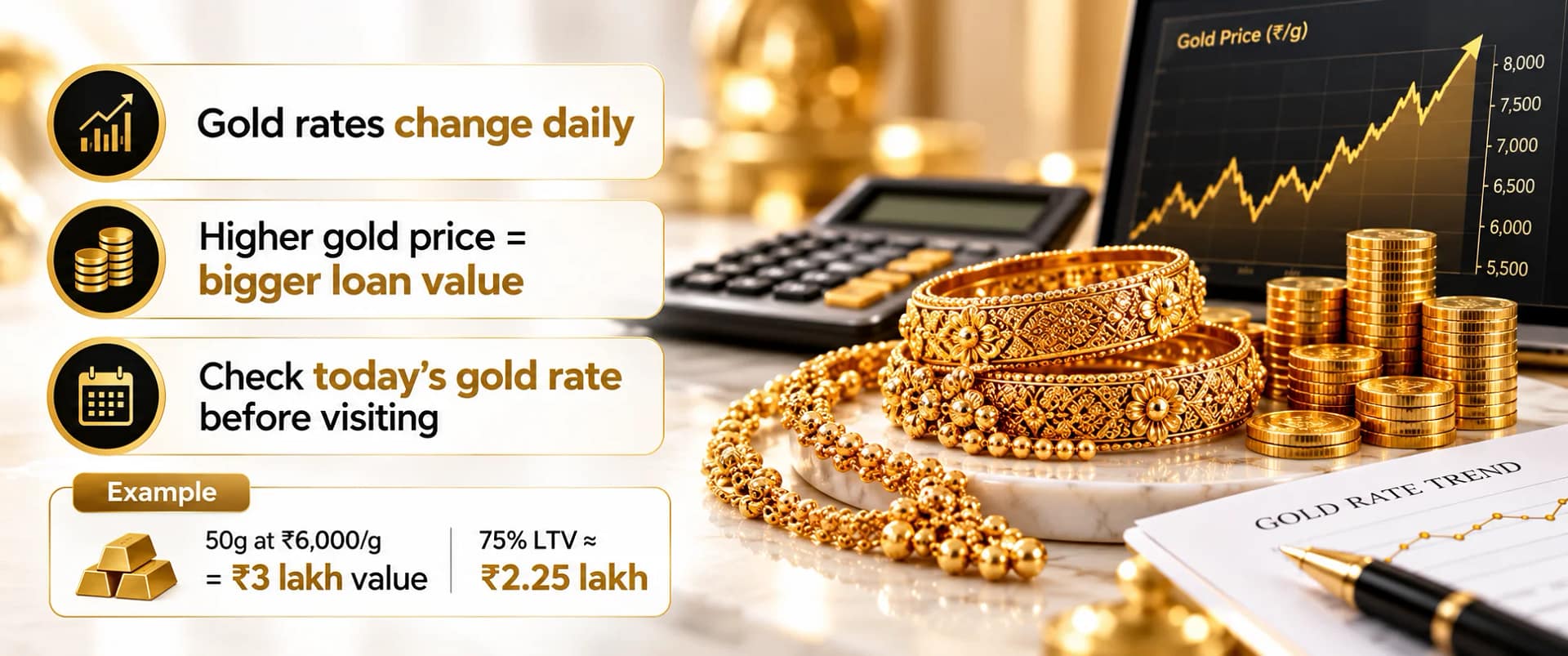
Gold prices change every day, and your loan amount moves with them. When prices go up, the same jewellery is worth more, so you can borrow more. When prices fall, that cushion gets thinner. RBI wants the LTV limit kept for the whole loan period, not only on day one, so lenders keep a close eye on the market.
For example, 50 grams of gold at ₹6,000 per gram is worth ₹3 lakh. If the lender gives 75% of the value, you get about ₹2.25 lakh. If the price rises to ₹7,000 per gram, the same gold is worth ₹3.5 lakh, and the loan can go up to about ₹2.62 lakh. The interest rate on that scheme stays the same.
Prices still matter after you take the loan. RBI wants the LTV limit maintained for the whole loan period, so if gold falls sharply, a lender may ask you to pay part of the loan or add more gold.
Tip: Check today’s gold rate before you visit the branch. High prices can mean a bigger loan on the same gold.
5. Tenure and Repayment Scheme
Short or long, EMI or bullet, the way you repay changes what you end up paying. In a bullet loan you pay the principal and interest together at the end. Since April 1, 2026, RBI caps consumption bullet loans at 12 months. Interest also keeps adding up every month you hold the loan, so a longer tenure usually means a bigger total bill.
Tip: Pick the shortest tenure you can handle comfortably. Less time means less imarket nterest, and you get your gold back sooner.
6. External Benchmarks & RBI Policy Rates
Many bank loan rates are tied to a benchmark, and gold loans can be too. SBI, for example, links its gold loan to its 1-year MCLR. On 7 October 2026, RBI raised the repo rate by 0.25 percentage points to 5.50%. Loans tied to the repo rate can get costlier at their next reset, while fixed-rate loans stay the same. This is why Gold Loan Interest Rates in India don’t stay still for long, and Bangalore lenders feel the same push.
Tip: Ask if your rate is fixed or floating before signing, and ask to see the lender’s interest rate policy. Fixed rates stay put when RBI changes the repo rate.
7. Borrower Income Stability
Lenders like to know you can pay the money back. For bigger loans, RBI requires a detailed credit assessment, including your repayment capacity, once the loan goes above ₹2.5 lakh. A steady income makes that check easier. For smaller loans, many lenders don’t dig deep because your gold is the security. An unsteady income usually means a stricter look at large loans.
Tip: Keep your salary slips or income proofs ready if you plan to borrow a big amount against your gold jewellery.
8. Type of Lender (Bank vs NBFC)
Banks usually start lower. SBI’s indicative gold loan rate was around 8.50% in January 2026. NBFCs approve faster and often need less paperwork, but one major NBFC’s schemes can go as high as 30% a year depending on the scheme, tenure and repayment type. Neither one is better in every case. It depends on whether you need the cheapest rate or the quickest cash.
Tip: Compare at least three lenders on monthly rate, yearly rate and charges. Don’t pick only on the lowest advertised number.
9. Competition in the Bangalore Market
Bangalore has banks, NBFCs and local gold loan companies all competing for the same customers, sometimes on the same street. That works in your favour. A lender who wants your business may offer a better rate or lower charges, so it’s worth asking. The first rate you hear isn’t always the final one.
Tip: Visit two or three branches in your area and ask for offers in writing. A little haggling can save money.
10. Type of Gold Loan Scheme
Most lenders run more than one scheme: a regular loan, an overdraft, a takeover from another lender, a top-up. Each one comes with its own rate and rules. Some are built for lower cost, others for speed or flexibility. Read the scheme details properly, not just the headline rate on the poster.
Tip: Ask the lender to list every scheme, then pick the one that matches your repayment plan, not only the cheapest.
How to Get a Gold Loan at a Competitive Interest Rate in Bangalore
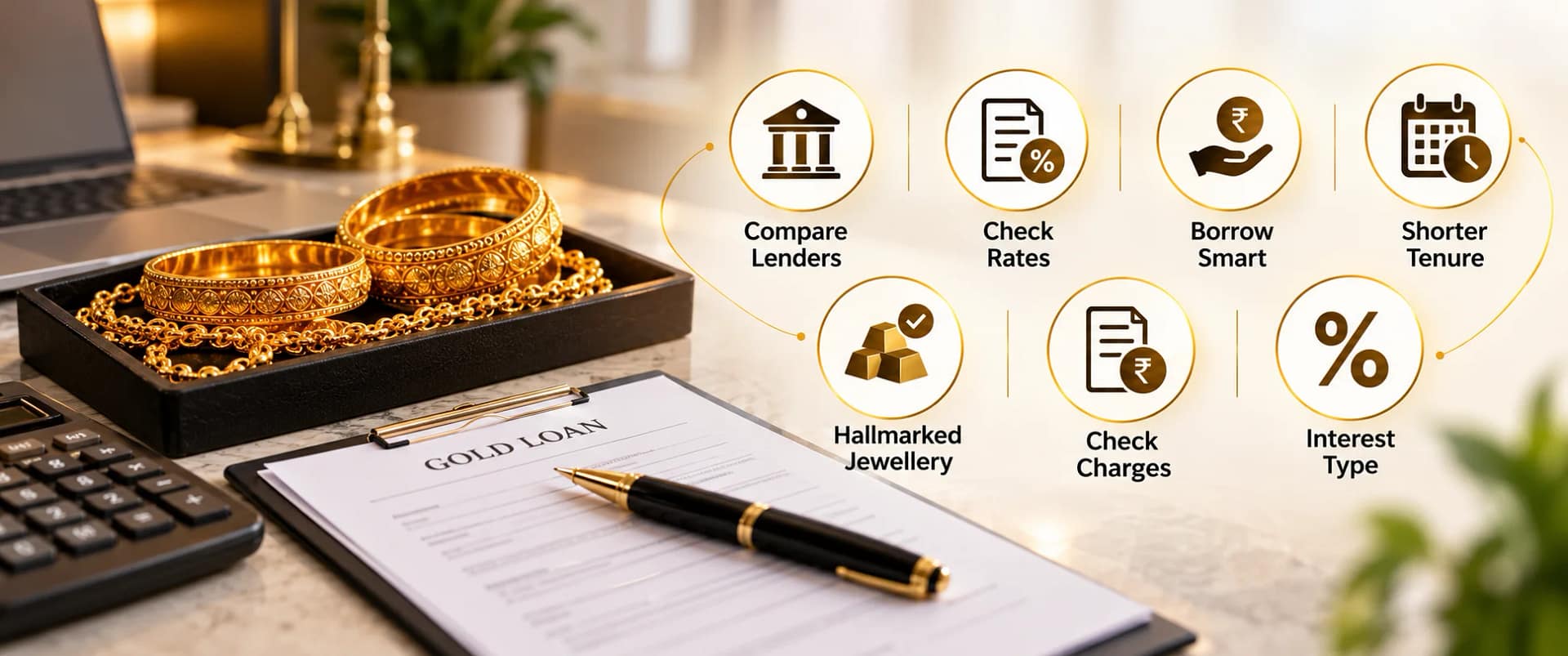
A lower rate doesn’t happen by accident. A little homework before you apply can cut your total cost quite noticeably.
- Compare at least three lenders, both banks and NBFCs
- Ask for the Gold Loan Interest Rate Per Month and the yearly rate in writing
- Borrow only what you actually need
- Choose the shortest tenure you can manage
- Carry hallmarked jewellery and ask how purity is tested
- Check processing fees and other charges before signing
- Ask if interest is flat or on the reducing balance
Small steps like these add up fast. Also ask how your pledged gold is protected, since gold loan insurance is something every borrower should understand. Do all this before you sign, and later surprises become a lot less likely.
Want to check your rate? Contact Us Sai Gold OGL for a clear quote.
Conclusion
So that’s the full picture. Your gold, loan size, tenure, repayment type, the lender you pick and even RBI’s repo rate all play a part in what you pay. There’s no single magic number for Gold Loan Interest Rates in Bangalore, which is exactly why comparing matters.
Before you pledge your gold, ask for the monthly and yearly rate, read the scheme properly and talk to a few lenders. If you want one that doesn’t check your CIBIL score and values gold using German XRF technology, Sai Gold OGL is worth a call.