
Interest rate is not the only factor that determines the cost of a diamond loan. When you are about to put up your diamond jewelry as collateral for a loan, you should be able to determine all the costs involved.
The diamond loan is something that might prove to be helpful if you wish to get cash without parting with your precious jewelry. The amount that can be borrowed and the cost associated with this process will be determined by the diamond’s valuation, Loan-to-Value (LTV), the interest rate, loan term, and the conditions set by the lender. Being aware of these factors in advance could allow you to make the right choice.
What Is a Diamond Loan?
A diamond loan is a secured loan where you pledge a diamond or diamond jewellery as collateral in exchange for funds. Instead of selling the jewellery permanently, you use its assessed value to obtain financing and can get the pledged asset released after meeting the repayment terms.
The amount you can borrow depends on how the lender evaluates the diamond and the applicable LTV. Sai Gold OGL says its diamond valuation considers the internationally recognised 4Cs: carat, cut, clarity and colour, along with certification and other appraisal factors.
For a diamond loan, lenders may consider:
- Diamond quality and carat weight
- Cut, colour and clarity
- Certification, where available
- Overall jewellery and setting
- Assessed market value
- Applicable LTV
- Loan tenure and repayment terms
Because diamond prices and valuations can vary significantly based on quality, the final loan amount cannot be determined from carat weight alone.
Diamond Loan Interest Rates and Charges: What Every Borrower Should Know
Before taking a diamond loan, look beyond the advertised interest rate and check every cost that can affect your final repayment amount.
Diamond Loan Interest Rates
The interest rate determines how much you pay for using the borrowed money. Lenders generally quote interest rates on an annual basis, but the actual amount payable depends on the outstanding balance, tenure and calculation method.
Sai Gold OGL’s current Diamond Loan Calculator uses 18% per annum as an illustrative rate. For example, its calculator shows a ₹3 lakh loan for six months with estimated interest of ₹27,000. This is an indicative calculation, not a guarantee that every borrower will receive the same rate.
The rate offered to you can depend on the lender’s policy, loan scheme, amount, tenure and assessment. Always check the sanction letter or Key Facts Statement (KFS) for the applicable rate before accepting the loan.
Interest Calculation Methods
Knowing the interest rate is not enough. You should also understand how interest is calculated.
For example, a simple illustration can be calculated as:
Interest = Principal × Annual Interest Rate × Time
Suppose you borrow ₹3,00,000 at an annual rate of 18% for six months:
₹3,00,000 × 18% × 6/12 = ₹27,000
So, the illustrative interest would be ₹27,000.
However, actual loan calculations can differ depending on the lender’s terms and the way interest is charged. Sai Gold OGL’s Fair Practices Code states that its interest rates are annualised and that interest is charged on the daily outstanding balance, based on the actual number of days from availing the loan to closure.
That means you should not assume that a simple six-month calculation will always match your final interest liability.
Before signing, ask:
- Is interest calculated on the daily outstanding balance?
- When does interest start accruing?
- How is interest calculated if I close the loan early?
- What happens if the loan continues beyond the original period?
Processing and Documentation Charges
Interest is usually the biggest borrowing cost, but it may not be the only one. A lender may charge a processing fee for evaluating and setting up the loan.
Sai Gold OGL states that applicable interest rates and other charges are communicated to borrowers, and its Fair Practices Code says the borrower should receive information about the interest rate, fees, repayment terms and other key loan details.
Before disbursal, check:
- Processing fee
- Documentation charges, if applicable
- Applicable taxes
- Whether charges are deducted from the disbursed amount
- Whether any additional service fees apply
For example, if your approved loan is ₹3 lakh but certain applicable charges are deducted before disbursal, the amount that reaches your bank account could be lower than the sanctioned amount. So, always ask for the net amount you will actually receive.
Diamond Valuation Charges
Valuation is particularly important with diamond loans because diamonds do not have a single uniform value based only on weight.
Sai Gold OGL says its diamond appraisal considers the 4Cs—carat, cut, clarity and colour—and certification from recognised laboratories can also be considered. The website states that the final loan amount is subject to physical appraisal by its certified evaluators at the branch.
The important point for borrowers is that you should ask whether any separate valuation or appraisal fee applies.
Do not assume a valuation charge exists, but do not assume it is free either. If there is a fee, ask:
- How much is it?
- Is it refundable?
- Is GST included?
- Is it deducted from the loan amount?
Getting this information before the appraisal can prevent confusion later.
Prepayment and Foreclosure Charges
If you have enough money to repay your diamond loan before the scheduled maturity date, check the lender’s prepayment or foreclosure terms.
Sai Gold OGL’s current Diamond Loan page states “No foreclosure fee” as one of the product benefits. However, borrowers should still confirm the applicable terms for their specific loan in the sanction letter or loan agreement. This is especially important because the lender’s Fair Practices Code contains a more specific statement about prepayment/foreclosure charges in the context of gold loans.
Before making an early repayment, ask for a written foreclosure statement showing:
- Outstanding principal
- Interest payable up to the closure date
- Any applicable charges
- Total amount required for closure
- Procedure for releasing the pledged jewellery
Late-Payment and Other Charges
Missing a repayment or allowing a loan to remain overdue can increase your overall borrowing cost.
The exact consequences depend on the loan agreement and the lender’s applicable policy. Sai Gold OGL’s Diamond Loan FAQ states that borrowers who cannot repay on time may receive reminders and formal notices and that prolonged non-repayment can lead to auction of the pledged diamond to recover the outstanding amount.
Before taking the loan, understand:
- Late-payment charges
- Additional interest, if applicable
- Consequences of overdue payments
- Renewal or restructuring options
- Notice and auction procedures
- Conditions for recovering the pledged jewellery
The safest approach is simple: understand the repayment schedule before pledging the diamond, rather than waiting until a payment becomes overdue.
Also Read: Diamonds vs Gold: Which Is the Better Investment Option?
How Diamond Valuation Affects Your Loan Amount
The value assigned to your diamond directly influences how much you may be able to borrow. Unlike gold, where weight and purity provide a relatively straightforward basis for valuation, diamonds are assessed using several quality characteristics.
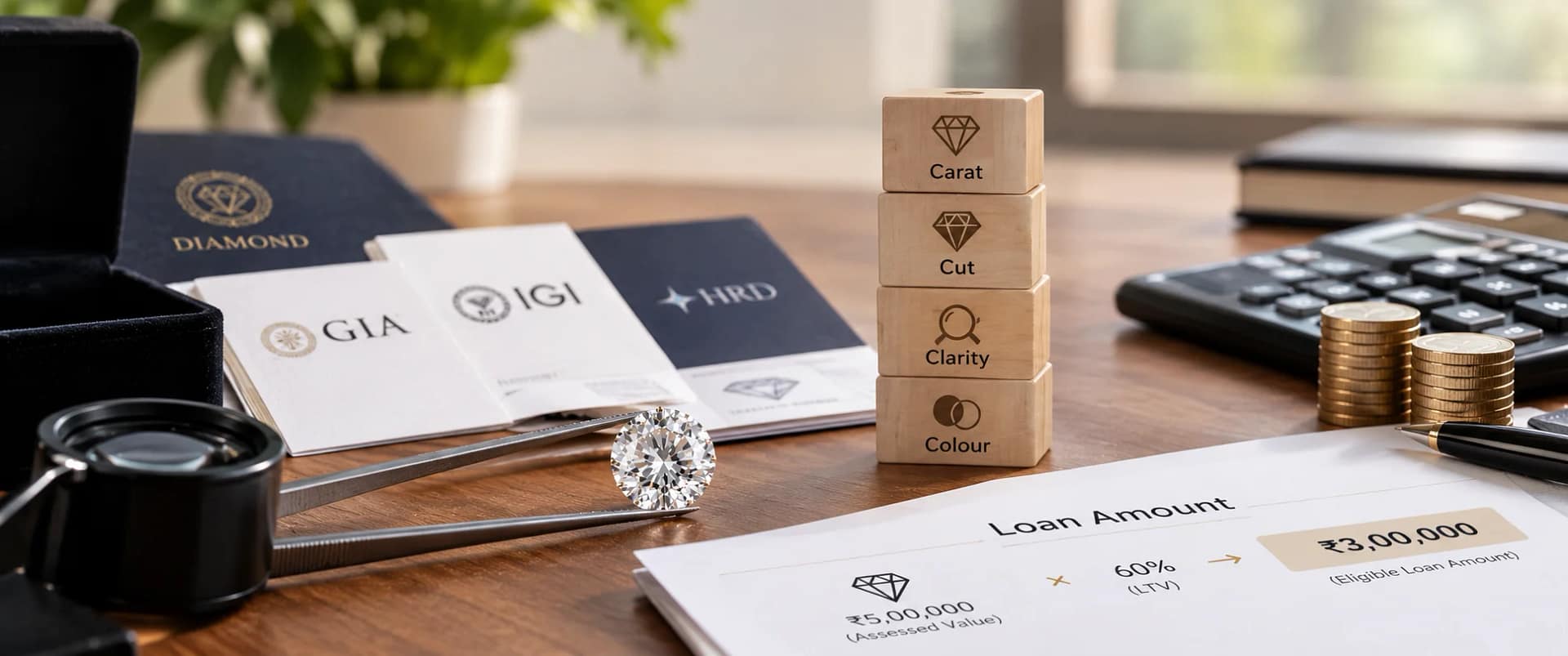
Sai Gold OGL says its appraisal considers the 4Cs—carat, cut, clarity and colour—and may consider certificates from recognised laboratories such as GIA, IGI and HRD. Its website currently states an indicative diamond LTV range of 60% to 75%, while its calculator uses 60% in its example.
For example, if a diamond is assessed at ₹5,00,000 and a 60% LTV applies:
₹5,00,000 × 60% = ₹3,00,000
So, the indicative eligible loan amount would be ₹3 lakh.
This is only an example. The actual amount depends on the lender’s appraisal and applicable loan terms. A higher-quality, well-certified diamond may be assessed differently from another diamond of the same carat weight.
Also Read: Can Diamond Jewellery Be Used to Avail a Gold Loan?
What Borrowers Should Ask Before Taking a Diamond Loan
Before signing the loan agreement, asking the right questions can help you understand the actual cost and repayment obligation.
- What interest rate will apply to my loan?
- How is the interest calculated?
- What is the total cost of the loan?
- How was my diamond valued?
- What LTV will apply to my diamond?
- Are there any prepayment or foreclosure charges?
- What happens if I miss a payment?
- When and how will I get my diamond back?
Common Mistakes to Avoid When Taking a Diamond Loan
A diamond loan can be useful, but overlooking small details can make the borrowing experience more expensive or complicated.
- Comparing only interest rates: A lower rate does not automatically mean a lower total cost if other applicable charges are higher.
- Ignoring the valuation method: Not understanding how your diamond is assessed can lead to unrealistic expectations about the loan amount.
- Borrowing more than necessary: Taking a larger loan than you need means paying interest on money that you may not actually require.
- Skipping the repayment terms: Always understand the due dates, overdue consequences, foreclosure rules and jewellery-release conditions before signing.
- Not checking the final documents: Never rely solely on verbal information. Review the sanction letter, KFS and loan agreement for the exact applicable terms.
A few minutes spent checking these details can make the actual cost and responsibilities of your diamond loan much clearer.
Final Thoughts
A diamond loan should not be judged by its interest rate alone. The real cost depends on the interest calculation method, applicable fees, diamond valuation, LTV, repayment schedule and other terms attached to the loan. Before pledging your jewellery, ask for a clear breakdown of what you will receive, what you will repay and what happens if you close the loan early or miss a payment. A transparent comparison helps you borrow only what you need and make a more informed financial decision.