

Have you ever wondered why two people with the same weight of gold jewellery get completely different loan amounts? One person walks out with ₹72,000. The other gets only ₹59,000. Same weight. Different loan. Why?
The answer is simple — gold purity.
When you apply for a gold loan, lenders do not just look at how heavy your gold is. They look at how pure it is. And that purity directly decides how much money you get in your hand. In India, gold prices have crossed ₹1.5 lakh per 10 grams in 2026. This means your gold jewellery sitting in the locker is now worth more than ever. But to get the maximum loan amount, you need to understand how gold purity works.
In this blog, we will explain everything — simply and clearly — so you can walk into any gold loan appointment fully prepared.
What Is Gold Purity?
Gold purity tells you how much real gold is in your jewellery. It is measured in Karats — the higher the karat, the purer the gold.
- 24K = 99.9% pure gold
- 22K = 91.6% pure gold
- 18K = 75% pure gold
In India, BIS hallmark certifies the purity of your gold jewellery officially.
How Different Gold Purities Affect Loan Amount
Here is the most important thing to understand — lenders only give you a loan on the pure gold content in your jewellery. Not the total weight. This is why purity matters so much when calculating your gold loan amount.
22K Gold Jewellery
22K gold is 91.6% pure. This is the most common gold used in Indian jewellery — your necklaces, bangles, earrings. Most lenders in India consider 22K as the standard for gold loan valuation. If you have 22K jewellery, you will get a good loan amount per gram. It is the sweet spot between purity and wearability.
18K Gold Jewellery
18K gold is 75% pure. It is commonly used in designer and lightweight jewellery. Since it has more alloy mixed in, the pure gold content is lower. This means your loan amount per gram will be less compared to 22K gold. For every 10 grams of 18K gold, only 7.5 grams is actual pure gold — so your loan eligibility is naturally lower.
24K Gold
24K gold is 99.9% pure — the purest form of gold. It gives the highest loan amount per gram among all purities. However, 24K is too soft for jewellery so it is mostly available as bank issued gold coins. If you have 24K gold coins from a bank, you can get the maximum possible loan value on them.
Gold Loan Amount Comparison: 18K vs 22K vs 24K Gold
Let us make this very simple with real numbers. Suppose today’s gold rate is ₹10,500 per gram for 24K gold. And you have 10 grams of gold jewellery.
Here is exactly how much loan you will get based on purity — at 75% LTV as per RBI guidelines:
| Gold Purity | Weight | Pure Gold Content | Rate Per Gram | Loan at 75% LTV |
| 24K | 10g | 9.99g | ₹10,500 | ₹78,750 |
| 22K | 10g | 9.16g | ₹9,639 | ₹72,292 |
| 18K | 10g | 7.50g | ₹7,875 | ₹59,062 |
What Does This Tell You?
Just by having 22K gold instead of 18K gold — you get almost ₹13,000 more on the same 10 grams. That is a big difference. And if you have 24K gold coins, you get even more.
This is exactly why gold purity directly affects your gold loan amount — and why you should always know your gold’s karat before applying.
Formula to remember: Loan Amount = Weight × Purity % × Gold Rate per Gram × LTV Ratio |
Factors That Affect Your Gold Loan Amount Besides Purity
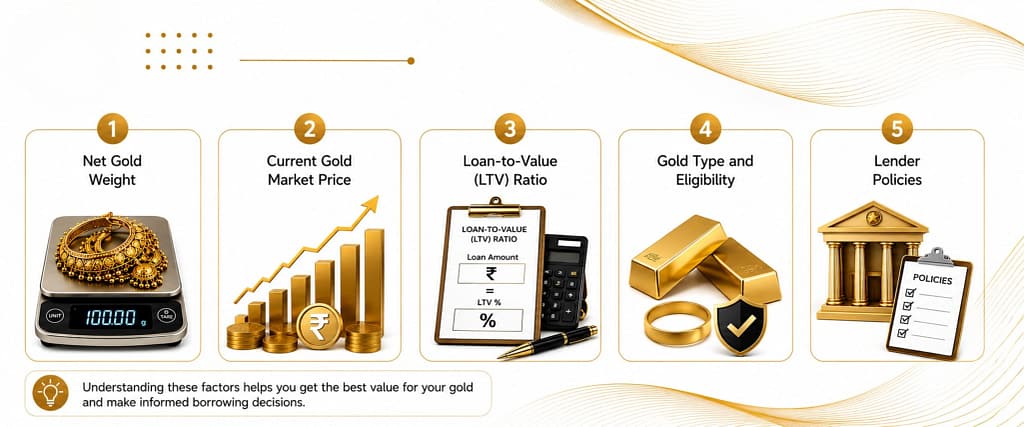
Purity is important — but it is not the only thing that decides your loan amount. Here are 5 other key factors every borrower must know before applying for a gold loan.
1. Net Gold Weight
Lenders do not count the total weight of your jewellery. They only count the net gold weight — which means stones, diamonds, meenakari work, and other attachments are removed before weighing. So if your necklace weighs 15 grams but has heavy stones, your actual gold weight could be 11 or 12 grams only. Always keep this in mind when estimating your loan amount.
2. Current Gold Market Price
Your loan amount also depends on the current gold rate on the day of valuation. Lenders in India use the 30-day average closing price published by the Indian Bullion and Jewellers Association (IBJA) — not just a single day’s price. This protects both the borrower and lender from sudden market fluctuations. Higher gold market price means higher loan amount for you.
3. Loan-to-Value (LTV) Ratio
LTV is the percentage of your gold’s value that the lender gives you as a loan. As per the New RBI guidelines effective 1 April 2026, the LTV structure is now tiered:
- Loans under ₹2.5 lakh → 85% LTV
- Loans between ₹2.5L to ₹5L → 80% LTV
- Loans above ₹5L → 75% LTV
This is great news for small borrowers — you can now get more money on the same gold than before.
4. Gold Type and Eligibility
Not all gold is accepted for a loan. Lenders in India generally accept:
- BIS hallmarked gold jewellery — 18K to 22K
- Bank issued gold coins — 22K and above
- Gold bars from private sellers
- Non-hallmarked gold may get lower valuation
- Gold ETFs or digital gold
BIS hallmarked jewellery always gets a faster and more accurate valuation — which means a better loan amount for you.
5. Lender Policies
Different lenders have different per-gram rates and valuation methods. This is why the same gold can get different loan amounts at different places. At Sai Gold OGL, we use a German XRF Machine and the Touchstone Method for 100% accurate gold valuation — so you always get the maximum loan amount your gold deserves. No undervaluation. No guesswork.
Also Read: Key Factors That Affect Gold Loan Interest Rates
How to Check Your Gold Purity Before Applying for a Gold Loan
Before you take a gold loan, make sure you check your gold’s purity first. Simple checks at home can give you a fair idea of what to expect — so there are no surprises when the lender does the official valuation.
Here are 7 easy ways to check your gold purity —
- Check the BIS Hallmark — Look for the BIS logo, purity mark like 22K916 or 18K750, and the 6-digit HUID code on your jewellery. These marks confirm your gold’s certified purity instantly.
- Check Your Purchase Bill — If you have the original invoice or certificate from your jeweller, check it. It usually mentions the karat — 18K, 22K or 24K — making purity verification quick and easy.
- Try the Magnet Test — Place a strong magnet near your gold jewellery. Pure gold is naturally non-magnetic. If your jewellery gets attracted to the magnet — something is not right.
- Try the Sink Test — Drop your gold into a glass of water. Real gold is dense and heavy. It sinks straight to the bottom immediately. Fake or impure gold behaves differently.
- Understand Net Weight — Lenders calculate your loan only on the actual gold weight — not the total jewellery weight. Gemstones, diamonds, glass and decorative materials are excluded before weighing.
- Know Your Karat Value — Higher purity means higher loan amount. 22K gold at 91.6% purity will always get you more loan per gram than 18K gold at 75% purity — on the exact same weight.
- Expect Professional Testing at the Branch — When you visit a lender, they will test your gold using XRF machines, Touchstone method or acid tests to accurately verify purity before approving your loan amount.
Checking your gold purity before applying saves time and sets realistic expectations. Home tests give you a good starting idea — but the lender’s professional testing is what finally decides your loan eligibility and amount.
Can Low-Purity Gold Get a Gold Loan?
Yes — but with conditions. Most lenders in India accept gold with a minimum purity of 18K. If your gold is below 18K, most lenders will not accept it as collateral. The loan amount on 18K gold will be lower per gram compared to 22K — because the pure gold content is less.
At Sai Gold OGL, we accept gold from 18K to 22K and give you the best possible valuation using accurate testing methods. So even if your gold is 18K, you can still get a good loan — just bring it in for a free check first.
Conclusion
Now you know the truth — gold purity is the single biggest factor that decides your gold loan amount. Higher the purity, higher the loan. It is that simple.
But knowing your purity is just the first step. Getting the right lender is equally important. At Sai Gold OGL — an RBI approved NBFC since 1997 — we use German XRF machines to give you the most accurate gold valuation. No undervaluation. No hidden charges. Loan approved in just 30 minutes. Whether your gold is 18K, 22K or 24K — we make sure you get the maximum loan amount it deserves. Do not let your gold sit idle in the locker. Turn it into instant cash today.
Contact Sai Gold OGL on WhatsApp right now and get your free gold valuation done — zero obligation, 100% transparent.