


A gold loan is often considered one of the easiest secured loans to obtain because the borrower pledges gold jewellery as collateral. However, submitting gold does not automatically guarantee approval. Banks and non-banking financial companies still evaluate the applicant’s documents, repayment ability, gold purity, ownership details, requested amount, and compliance with internal lending policies.
A gold loan rejection can be frustrating, especially when funds are urgently required for medical expenses, education, business needs, home repairs, or other financial emergencies. Fortunately, many rejection reasons can be identified and corrected before submitting a fresh application.
This guide explains the most common reasons why a gold loan application gets rejected and the practical steps borrowers can take to improve their chances of approval.
1. Low Purity of Gold
One of the most common gold loan rejection reasons is insufficient gold purity.
Many lenders accept ornaments within a defined purity range. For example, SBI describes typical eligible purity as between 18 and 24 carats, while an ICICI Bank eligibility calculator uses purity between 18 and 24 carats to estimate the maximum loan amount.
If the jewellery contains a large percentage of other metals, its eligible gold value may be significantly lower than expected.
Solution
Before applying, ask the lender about its minimum acceptable purity. Consider having the jewellery checked by a trusted jeweller, although the lender will conduct its own valuation.
Do not rely only on the jewellery’s purchase invoice or hallmark. The lender’s authorised valuer will determine the eligible purity and net gold content.
Also Read: Different Grades of Silver Explained: Purity, Uses & Value
2. Insufficient Net Gold Weight


Jewellery may look heavy, but the lender calculates only the eligible gold content.
The following components may be excluded from valuation:
- Stones
- Pearls
- Beads
- Enamel work
- Threads
- Hooks
- Non-gold attachments
- Decorative materials
- Other embedded metals
A 50-gram ornament may therefore contain substantially less eligible gold after deductions.
Solution
Choose ornaments with higher net gold content and fewer stones or decorative components. Ask the lender for a valuation breakdown if the eligible loan amount is lower than expected.
Adding more acceptable gold ornaments may also help meet the required loan amount.
3. Asking for a Loan Amount Higher Than the Eligible Value
A borrower may request an amount that exceeds the value permitted against the pledged jewellery.
The maximum eligible amount depends on:
- Net gold weight
- Gold purity
- Applicable market price
- Loan-to-value ratio
- Lender’s internal policy
- Interest and repayment structure
- Type of gold loan scheme
RBI guidance has historically required regulated lenders to maintain limits on the loan-to-value ratio for loans against gold jewellery. The lender therefore cannot simply finance the jewellery’s entire retail purchase price.
Solution
Use the lender’s gold loan eligibility calculator before applying. Request an amount based on the assessed gold value rather than its showroom price.
You can reduce the required amount, pledge additional eligible jewellery, or compare loan offers from regulated lenders.
Also Read: Factors That Influence Gold Loan Rate Calculation Per Gram
4. Incomplete KYC Documents
Incomplete or missing documentation can delay or result in gold loan rejection.
Commonly required documents include:
- Completed application form
- Passport-size photographs
- Identity proof
- Address proof
- PAN or other tax-related documentation, where applicable
- Additional category-specific documents
ICICI Bank lists identity and address documents such as Aadhaar, passport, voter ID, and driving licence among accepted records for gold loan applications.
Solution
Ask the lender for an updated document checklist before visiting the branch.
Carry original documents and clear copies. Check that all documents are valid, readable, and consistent. Submit any additional records immediately when requested.
Also Read: Handy Checklist to Simplify Your Gold Loan Application Process
5. Mismatch in Personal Details
Differences between the application form and KYC documents can raise verification concerns.
Common mismatches include:
- Different spellings of the applicant’s name
- Old and new residential addresses
- Incorrect date of birth
- Unmatched signatures
- Different mobile numbers
- Incomplete initials
- Incorrect identification numbers
Even a small error can delay approval when the lender cannot verify the applicant’s identity.
Solution
Complete the application exactly as the details appear on the primary KYC documents.
Update outdated documents before applying. If a genuine name or address difference exists, provide supporting records such as a marriage certificate, gazette notification, updated Aadhaar, utility bill, or other accepted proof.
6. Applicant Does Not Meet the Age Criteria
Gold loan eligibility includes minimum and maximum age requirements. These requirements differ between lenders and repayment plans.
For example, HDFC Bank currently states that Indian residents between 18 and 75 years of age may apply for its gold loan, subject to the lender’s other eligibility conditions.
Applications from underage borrowers or applicants above the lender’s maximum permitted age may be rejected.
Solution
Check the lender’s age requirements before applying. When permitted, an eligible family member who legitimately owns the gold may apply independently.
Do not provide false ownership or applicant information to bypass eligibility conditions.
7. Doubts About Ownership of the Gold
Lenders must be satisfied that the applicant has the legal right to pledge the jewellery.
An application may face rejection or additional verification when:
- Ownership information appears inconsistent
- The applicant gives unclear answers
- The jewellery is linked to a dispute
- The ornaments appear suspicious
- The applicant cannot explain how the gold was acquired
- Someone else claims ownership
- The transaction triggers enhanced due diligence
Solution
Pledge only gold that you legally own or are authorised to pledge.
Carry the purchase invoice when available, particularly for recently purchased ornaments. Be prepared to provide a reasonable and truthful explanation of ownership if the lender requests clarification.
8. The Jewellery Type Is Not Accepted
Not every gold item is automatically accepted for a personal gold loan.
A lender may refuse or restrict:
- Gold-plated jewellery
- Imitation ornaments
- Gold bars
- Bullion
- Certain gold coins
- Ornaments with very low net gold content
- Jewellery with excessive stones
- Damaged items that cannot be valued reliably
- Items that fail authenticity checks
Some lenders accept only specified categories of bank-issued gold coins. SBI, for example, states that its personal gold loan may be offered against gold ornaments and specially minted gold coins sold by banks, subject to its stated limits and conditions.
Solution
Confirm the lender’s acceptable collateral list before applying. Take hallmarked gold ornaments with clear, measurable gold content wherever possible.
Do not assume that investment bars, exchange-traded gold, digital gold, or all types of coins can be pledged under a jewellery-backed loan scheme.
9. Poor Repayment Capacity
A gold loan is secured, but the lender still expects the borrower to repay it.
The applicant may be asked about:
- Monthly income
- Business earnings
- Agricultural income
- Existing loan instalments
- Regular expenses
- Proposed repayment source
- Employment or occupation
- Previous borrowing history
SBI states that income proof may not always be required for its personal gold loan, but the borrower should still have the capacity to repay.
Solution
Choose a loan amount and tenure that fit your actual budget. Provide income evidence when requested, even when it is not part of the standard documentation.
Select a suitable repayment option, such as regular EMI, overdraft, or bullet repayment, only after understanding the interest obligations and maturity payment.
10. Poor Credit History or Existing Overdues
Gold loans may be more accessible than unsecured loans, but some lenders still review the applicant’s credit profile, existing defaults, overdue amounts, or previous repayment behaviour.
A poor CIBIL score may not always lead to automatic rejection because the loan is secured. However, serious defaults, write-offs, fraud indicators, or unpaid obligations can affect the lender’s internal risk assessment.
Solution
Review your credit report before applying, particularly if you have experienced previous loan defaults.
Correct inaccurate records through the credit bureau and concerned lender. Clear overdue payments where possible and carry supporting evidence when a settled or closed account has not yet been updated.
Avoid submitting applications to several lenders within a short period.
11. Existing Gold Loan Obligations
An applicant may already have one or more active gold loans with high outstanding balances.
A lender may reject a new application when:
- Existing repayment commitments are too high
- Earlier gold loan payments are overdue
- The same jewellery has already been pledged
- The applicant has repeatedly rolled over loans
- Repayment capacity appears insufficient
- Previous pledged gold has entered the auction process
Solution
Repay or regularise existing overdue accounts before submitting a new application.
Never attempt to pledge the same jewellery with multiple lenders. If refinancing is required, ask a regulated lender about a formal gold loan balance transfer instead of concealing existing obligations.
12. Incorrect or Suspicious Information
A lender may reject a gold loan when information in the application appears inaccurate, misleading, or suspicious.
Examples include:
- False income details
- Incorrect employment information
- Fabricated documents
- Misrepresented gold ownership
- Unexplained differences in signatures
- Suspicious transaction patterns
- Incorrect loan purpose
- Attempts to avoid verification
Solution
Provide complete and truthful information. Review the application carefully before signing it.
Never allow an unauthorised agent to submit false documents or alter information on your behalf. Misrepresentation can lead to rejection, account restrictions, legal consequences, or reporting to relevant authorities.
13. Gold Valuation Is Lower Than Expected
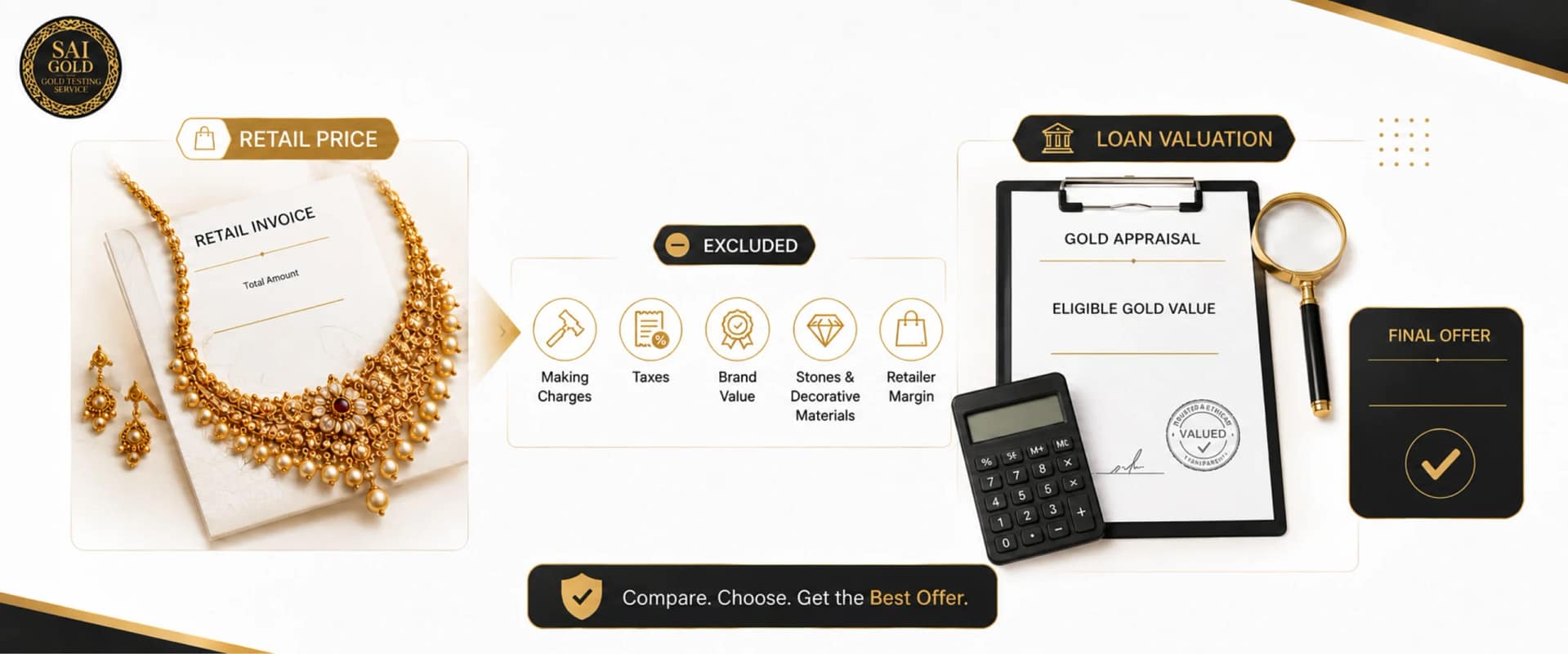
Borrowers often compare the loan amount with the retail price paid for the jewellery. However, retail jewellery prices include components that may not be considered for loan valuation, including:
- Making charges
- Designer premiums
- Taxes
- Brand value
- Stones and decorative materials
- Retailer margins
The lender primarily values eligible gold content using its applicable valuation method.
Solution
Set realistic expectations before applying. Ask for the assessed purity, eligible weight, applied gold value, and loan-to-value calculation.
Compare the final amount offered rather than assuming that another lender will value the jewellery according to the original invoice price.
14. Failure to Meet the Lender’s Internal Policy
Every bank and NBFC has internal lending standards in addition to regulatory requirements.
An application may not fit the lender’s policy because of:
- Unsupported customer category
- Restricted branch location
- Minimum or maximum loan limits
- Ineligible loan purpose
- Internal risk parameters
- Inadequate repayment profile
- Unacceptable gold type
- Adverse verification results
Lenders may communicate the principal reason for rejecting an application under their fair-practice processes, although internal risk models may not always be disclosed in detail.
Solution
Request the reason for rejection in writing. Ask whether the issue can be corrected by providing additional documents, reducing the loan amount, selecting another product, or meeting a different eligibility condition.
Apply elsewhere only after understanding the original problem.
15. Technical or Verification Problems
A gold loan application may be delayed or closed because of technical issues rather than financial ineligibility.
Possible problems include:
- Failed OTP verification
- Inactive mobile number
- Aadhaar authentication failure
- Unreadable scanned documents
- Incorrect application entry
- Duplicate customer records
- Bank account verification failure
- System or branch-processing errors
Solution
Confirm that your registered mobile number is active and linked to the necessary records.
Ask the lender whether the application was formally rejected or merely placed on hold. Correct the technical problem and request reprocessing instead of immediately submitting multiple fresh applications.
Also Read: KDM vs Hallmark vs BIS 916: Understanding the Difference in Gold Types
Can You Reapply After Gold Loan Rejection?
Yes, you can generally reapply after correcting the reason for rejection.
For example:
- Submit missing documents
- Correct KYC mismatches
- Add eligible ornaments
- Reduce the loan amount
- Clear existing overdues
- Choose another repayment structure
- Apply after updating your credit report
- Select a lender whose eligibility policy matches your profile
Reapplying immediately with unchanged information is unlikely to produce a better result and may create multiple loan enquiries.
Common Mistakes to Avoid When Applying for a Gold Loan
Applicants should avoid:
- Assuming every gold item is acceptable
- Requesting the full retail value of jewellery
- Ignoring stones and non-gold weight
- Submitting expired KYC documents
- Providing inconsistent information
- Hiding existing overdue loans
- Using unauthorised agents
- Signing blank documents
- Selecting an unaffordable bullet repayment plan
- Ignoring interest and penal charges
- Applying to unregulated lenders
- Failing to collect a valuation or pledge receipt
Always read the loan agreement before accepting disbursal.
Final Thoughts
A gold loan rejection does not necessarily mean that you are permanently ineligible. Applications are often rejected because of low gold purity, insufficient net weight, unrealistic loan amounts, incomplete documentation, ownership concerns, KYC mismatches, existing defaults, or lender-specific policies.
The best response is to understand the precise reason, correct it, and reapply carefully. Avoid rushing to unknown lenders simply because they promise instant approval.